

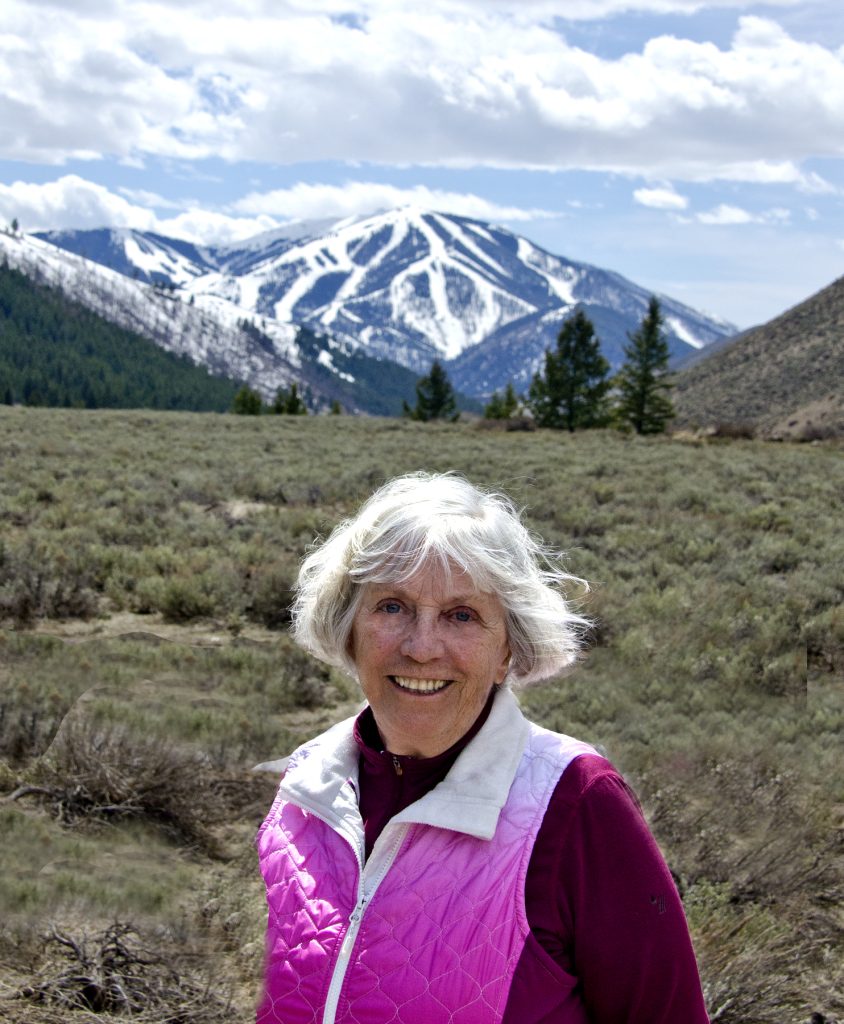
The literary excerpt contained below was graciously shared by our longtime friend and supporter Julie Weston (pictured at right). Julie grew up in Idaho and practiced law for many years in Seattle, Washington. Her book, The Good Times Are All Gone Now: Life, Death and Rebirth in an Idaho Mining Town (University of Oklahoma Press, 2009), won Honorable Mention in the 2009 Idaho Book of the Year Award. Her mystery books, all set in 1920s Idaho, number 6 and she is working on 7. All of her books are available at Bookshop.org, local bookstores, and Amazon. Most of her mysteries have received awards from the WILLA Award to the May Sarton Literary Award and to Foreward and Will Rogers Medallion Awards in Bronze. Julie and her husband Gerry live in central Idaho.
In the snow north of town, Nellie was alone in the world. All she saw and felt at that moment belonged to her and to no other soul. Although she could not yet see the moon, she beheld its effects. She had identified Jupiter, Saturn, Orion’s Belt, but they paled in comparison to the dazzle on earth. The snow meadow at her feet glistened like an ever-shifting dune of stardust. Tufts of long wheat-like grass cast precise, narrow shadows on the snow, as did the crooked reaching arms of aspen trees. …
The silence alone was worth the effort. She wished she could photograph it, so that anyone viewing the photo would feel drawn in and given respite from the noise of the world, the same way Nellie felt. For a long moment more, she gathered in the night, the snow, the shadows, the quiet, the cold. Then she turned to work, sorry to disturb the serenity of scene and self. Setting up her equipment took time. Waiting for the moon to rise above the eastern mountain took patience. Waiting for it to move would take more. The six sheets of film in her pack should be enough.
She untied the sled’s rope from her waist and plowed in her snowshoes closer to the grass tufts. Yes, the grass in the foreground, the aspen trunks white in moonlight against the dark fir background. Until the moon rose higher, this would do. She stepped in her own trench back to the sled and moved it another dozen feet closer to her envisioned photo. …
The moon topped the mountain and was so white, so astonishing, Nellie gasped. The man in the moon beamed down at her and she grinned back. Really, she wanted to whoop with joy, but Rosy might think she was in trouble.
With her tripod on as firm a footing as she could manage with her large 4×5 view camera attached to it, she retrieved her black cloth and covered her head and the camera to look at the scene reflected on the ground glass, then opened the shutter and moved the bellows on its rails to focus. The scene of wheatgrass, aspen, and snowy background was upside down and inverted, allowing her to see pattern and composition rather than objects. After a few more adjustments, as the light grew brighter and the shadows deeper, she set the aperture and shutter, slid in the film holder at the camera back, and removed the dark slide that protected it from light. From her pocket she drew a round timepiece, a present, her mother had said, one that had been intended for a son. Her mother’s statement had been tinged with embarrassment, but also, Nellie liked to think, a smattering of pride.
The light was strong enough to see the second hand. At the hour, Nellie opened the shutter and followed the sweep hand around once, twice . . . A sound somewhere off to her right caused her to look up briefly, but she didn’t lose her place. Five minutes. That should be enough, she guessed, and closed the shutter, replaced the dark slide, extracted the film holder, wrapped it with velvet cloth for protection, and placed the bundle in the film case with the unexposed sheets.
Nellie peered toward the direction of the sound but heard nothing more and saw no motion. A still night. A forest critter, perhaps, watching her. That gave her a queer feeling, but she shrugged and went back to work.
Silver light bathed the meadow and the cabin she had ignored while focusing on the first photo. Last Chance Ranch, but this time she was on the other side of it and much farther from the road. The moon and the abandoned building might work to convey what existed in the West side by side—beauty, dereliction and hard work, disappointment and riches. ….
After a short rest on her sled, she set up the tripod and camera and focused again. To complete a photo with the moon in it, she would have to take one picture of the cabin first without the moon in it, then wait for the moon to rise higher, and take the same picture on the same sheet of film with the moon. Otherwise, during the time the shutter would have to be open to capture the cabin, the moon would move, creating a blur. So she would take two photos of the same scene—one without and one with the moon.
*****
She scouted toward the river to hear the whooshing sound muffled by snow, similar to a train on tracks in the long distance. A series of sharp yips from across the river raised gooseflesh on her arms. Coyotes? Wolves? Her trip alone at night became a foolish venture before the echoes died away and all was quiet again. This night, this place, belonged to the creatures of the dark. The moon’s expression became a leer. She wished she had a lantern. What if she lost her way back?
The photo, remember the importance of the photo. The moon’s arc traveled above the cabin. If the scene wasn’t as bright as daylight, it seemed so because of the surrounding snow. With full moonlight illuminating the cabin, that should be enough to bring out the flat cut logs of the side wall and the pattern of river rock in the chimney.
The moon slid behind a cloud and Nellie shivered. She had been photographing for several hours. It was too cold and too late to take another photo with and without the moon. It was during a last look around that she heard a tapping, over and over, so soft it might have been background noise for some time.
What was it? She studied the cabin again. This time, she saw at the side window a reflected gleam that came and went, a flash, and not regular. The sound was a tapping on glass.
The road was too far away to see. Her knees shook. She didn’t want to admit she was afraid. Instead, she began to re-trace her snow trough. Then the snowshoe thong holding her boot broke. The moon was slipping toward the trees. Yips began again. Tap, tap, tap.
Nellie debated trying instead for the house. There were no such things as ghosts. The distance was hardly a hundred yards, and it was much farther to the auto. Coyotes, not wolves. She had told Rosy hours. Scrambling to the house was going to be difficult with only one snowshoe. “No ghosts.” Her own voice reassured her.
Pushing her sled to break a path, Nellie struggled toward the cabin, arriving at the door as the moon dropped to the line of mountains. The tap, tap, tap sound moved from the window to the door. When she turned the handle, the door opened and Nellie fell forward.
A black shape leaped up on her, grunting and squeaking, and a tongue slathered her face with saliva as she dropped to her knees. A dog. He wiggled and squirmed and then barked, a half-bark, half-yip. Nellie sat back on her heels and pushed the animal away. “You’re not a ghost!” Then, in the last glow from the moon, she saw the form of a man splayed out on the floor, his face a mask of ice, one hand visible, his fingers curled around an axe.
MOONSHADOWS by Julie Weston: Nellie Burns, photographer, leaves Chicago in the early 1920s to find adventure and a career in the West. Armed with her large format camera, Nellie photographs moonshadows on snow. She then stumbles onto a not quite deserted house and a black dog she names Moonshine. She also discovers and photographs a dead body. More info: www.julieweston.com